 Neuschwanstein from Munich
The Marienbrücke (Mary's Bridge) at Neuschwanstein
The Marienbrücke is the narrow iron footbridge behind Neuschwanstein Castle, and it gives the classic view of the towers against the Pöllat gorge. This guide covers what the view is like, the history of the bridge, how to reach it from the village, when it closes, and which Neuschwanstein tours from Munich leave enough time to walk onto it.
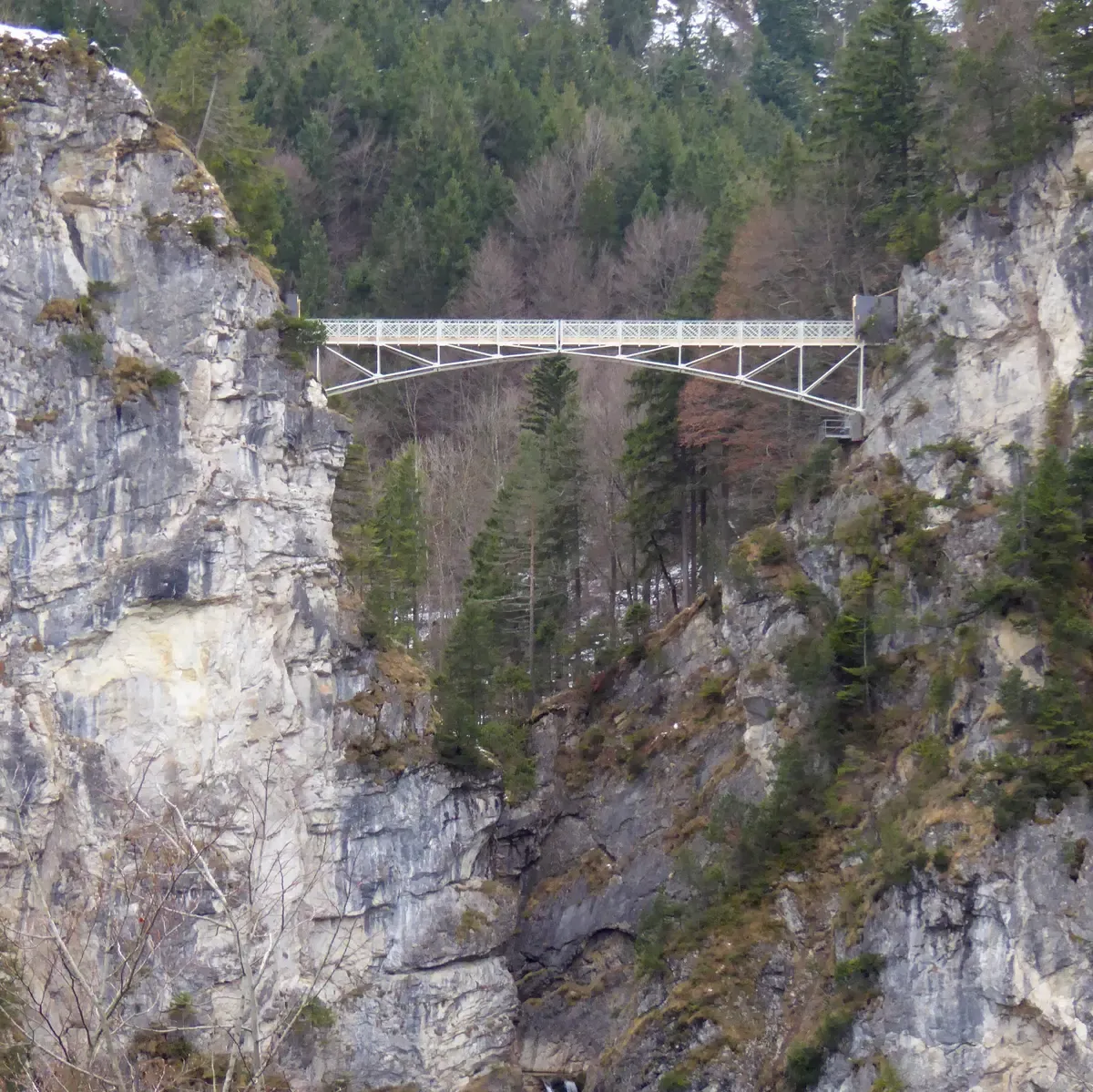
The Marienbrücke over the Pöllat gorge, 5 minutes from the shuttle stop. Photo: Николай Максимович, CC BY 3.0, via Wikimedia Commons
Quick answer The Marienbrücke at a glance
The Marienbrücke (Mary's Bridge) is the iron footbridge across the Pöllat gorge directly behind Neuschwanstein Castle, and it gives the classic view of the castle you have seen in every photo. The shuttle bus from the P4 parking area costs €3.50 ($3.99) up or €5.00 ($5.70) round trip, runs on demand with no timetable, and leaves you 5 minutes from the bridge. It closes often, usually for much of the winter, because of ice, snow or storms.
Key takeaways
- See the small-group van tour with hotel pickup, which builds the Marienbrücke and a gorge walk into the day.
- Buy the castle ticket before you ride the shuttle up, because the Ticket Center is down in the village. Details on the Neuschwanstein tickets page.
- From November the bridge often closes and the shuttle stops. A winter tour from Munich works even when the bridge is shut.
- Plan the whole day with the guide to Munich to Neuschwanstein.
What You See From the Marienbrücke
The bridge spans the Pöllat gorge behind the castle, about 45 minutes on foot above the village of Hohenschwangau.
The Classic Postcard View
Stand in the middle of the Marienbrücke, look back, and you get the view of Neuschwanstein that appears on posters, chocolate boxes and phone wallpapers. The castle sits on a rock ledge with its towers stacked against the hillside, and the gorge drops away below the bridge deck. On a clear day the Alps line the horizon. It is the only spot where the whole silhouette fits in one frame, which is why almost every visitor climbs here.
Two honest warnings. The bridge is a steel lattice walkway with high mesh sides, and it moves slightly underfoot when the crowd shifts. If you are uncomfortable with heights, stand near the entrance end and shoot from there. And in the peak months of July and August there can be a queue simply to step onto the bridge itself, so the photo takes longer than the walk.
How Much Time to Allow
Ten to twenty minutes is enough for most people: the walk from the shuttle stop, the photos from the deck, and the walk on. Tours budget it differently. The half-day tour allows the Marienbrücke and the 30-minute castle tour and nothing more, while the late-start coach tour sets aside about 1 hour at the bridge.
If you want time to sit, eat and walk the gorge as well, look at the tours on the Neuschwanstein castle tour from Munich comparison rather than the fastest options.
Sources: hohenschwangau.de
A Short History of Mary's Bridge
The bridge is older than the castle itself in its first form, and it was named after a queen.
From a Wooden Footway to an Iron Span
The first bridge on the site was wooden, built by Maximilian II in the 1840s so the royal family could enjoy the gorge below their hunting lodge of Hohenschwangau, the castle Ludwig II grew up in. When Ludwig II began building Neuschwanstein above the gorge, he replaced his father's wooden bridge with an iron one in 1866 and named it after his mother, Queen Marie. That is where both names, Marienbrücke and Mary's Bridge, come from.
Ludwig laid the foundation stone of the castle on 5 September 1869, so the bridge predates the castle by three years. He spent only 172 days in his finished rooms before his death in Lake Starnberg on 13 June 1886, and the castle opened to paying visitors about seven weeks later. The bridge has been the viewing platform for those visitors ever since.
Sources: hohenschwangau.de
How to Reach the Marienbrücke
Everything starts in the village of Hohenschwangau, 118.2 km from Munich. From there you either ride the shuttle bus or walk.
The Shuttle Bus from P4
The shuttle bus leaves from the P4 parking area in Hohenschwangau and climbs to the Jugend viewpoint above the castle. It costs €3.50 ($3.99) for a single ride up and €5.00 ($5.70) for the round trip. There is no timetable at all: the bus runs on demand, so you wait at the valley stop until it fills or departs. From its last stop it is a 5-minute walk to the Marienbrücke and about 15 minutes back down to the castle entrance. That makes it the easiest route for anyone who does not want the 30-40 minute uphill hike.
The same bus stops in snow and ice, which in practice means it can vanish from November to spring. If the bridge is open but the bus is not, the only way up is on foot.
Walking Up from P4
The walk from the P4 parking area to the Marienbrücke takes about 45 minutes on a steep path. It is not technical, but it climbs steadily and needs normal shoes. The walk up to the castle itself from the Ticket Center is about 1.5 km and takes 30-40 minutes, and the bridge sits beyond the castle on the same hillside.
Horse-drawn carriages leave near Hotel Müller for about €8 up and €4 down from April to October, weather permitting, but they stop roughly 450 m (10-15 minutes) below the castle entrance and do not serve the bridge, so the last stretch is always on foot.
Your Options Compared
The table sets out every way of getting up the hill from Hohenschwangau village to the Marienbrücke, with the fares and walking times taken from the official Hohenschwangau sources. Pick based on knees, weather and how the day is going, not on speed alone, because the bus timetable does not exist and the carriage does not reach the bridge.
| Route | Cost | Time | Notes |
|---|---|---|---|
| Shuttle bus from P4 to the Jugend viewpoint | €3.50 ($3.99) up, €5.00 ($5.70) round trip | 5-minute walk to the bridge from the stop | Runs on demand, no timetable, stops in snow and ice |
| Walk from P4 to the Marienbrücke | Free | About 45 minutes | Steep path, the only option when the bus is not running |
| Horse carriage from near Hotel Müller | About €8 ($9.12) up, €4 down | 10-15 minutes, then more on foot | April to October, weather permitting, stops 450 m below the castle, not at the bridge |
Sources: hohenschwangau.de, neuschwanstein.de
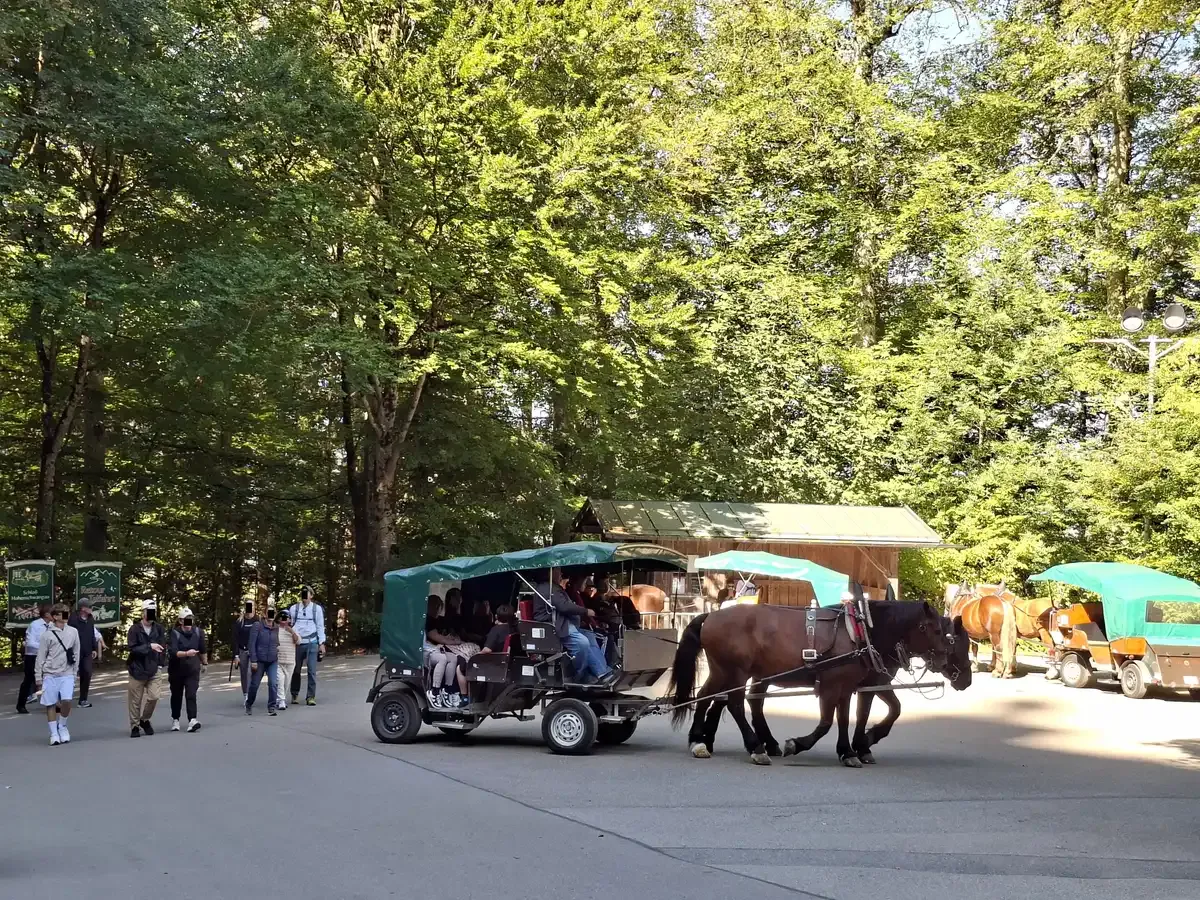
A horse-drawn carriage on the road up, about €8 uphill. Photo: Asurnipal, CC BY-SA 4.0, via Wikimedia Commons
Buy the Castle Ticket First, Then Go Up
The most common Marienbrücke mistake is going up before buying the castle ticket.
Why the Order Matters
Castle tickets are sold only online or at the Ticket Center in Hohenschwangau village, never at the castle door. The Ticket Center sits down in the valley, so once you ride the shuttle up you cannot buy anything until you come back down. An adult ticket costs €21 ($23.95) plus a €2.50 ($2.85) online booking fee, under 18s are free but still need a timed ticket, and the guided interior tour lasts about 30-35 minutes. Every ticket, child tickets included, carries that €2.50 fee online. The Neuschwanstein tickets page has the full price list for both castles.
A limited number of same-day tickets go on sale at the Ticket Center from 8:00, and on busy days they are gone by late morning. If the castle interior matters to you, secure it before you set foot on the shuttle.
Queues on Summer Days
In July and August the timed castle slots can sell out 2-3 weeks ahead, and the Marienbrücke itself develops a queue at its entrance, with visitors waiting in line to walk onto the deck for the photo. Mike's Bike Tours warns of this on its high-season departures. The practical fixes are simple: go early, accept that the mid-afternoon bridge can mean a 15-20 minute wait, or travel in May, June, September or early October, when temperatures run 15-22 C and the crowds thin out.
When the Marienbrücke Is Closed
The bridge closes often, and the closure is the single biggest planning factor for a winter day trip.
Winter and Storm Closures
The Marienbrücke can close for ice, snow or storms, usually for much of the winter. From November closures become common, and the shuttle bus and the horse carriages generally stop as well, so even the approach is off. When everything is shut, the classic view of the castle is gone with it, and the best you can do is photograph the castle from the village and the valley viewpoints. In winter no buses run up the hill at all on the private tour, which substitutes a 20-minute hike from the village when conditions allow.
If the bridge being open is the reason for your trip, check the official status before you travel and favor the months from spring to mid-October. The castle itself closes on 24, 25 and 31 December and 1 January, and winter interior tours run 10:00-16:00 against 9:00-18:00 in summer.
What Is Still Worth It Without the Bridge
A day with the bridge closed is not a wasted day. The village, the Alpsee lake and the two castles from below still fill the hours, and the interior tour runs as normal. Both Mike's winter day with the Christmas market walk and the two-castle coach days are built around the assumption that winter conditions can shut the hillside, so they never promise the bridge.
Which Tours From Munich Give You Time on the Bridge
Almost every full-day tour includes the Marienbrücke. The only one that squeezes it is the half day.
How the Day Splits
Every tour spends about 2 hours each way on the road or rails, because Hohenschwangau is 118.2 km from Munich, roughly 1 hour 45 minutes by car with no traffic. The difference is what happens in between. The Neuschwanstein-only coaches and train tours spend most of the day in the village with the bridge and the castle. The Linderhof coach days cut the Neuschwanstein time to about 2-3.75 hours but still fit the bridge in. The half-day tour allows only the 30-minute castle tour and the bridge, back in Munich at 2:20 PM. The comparison table on the Neuschwanstein tours from Munich homepage shows the time split for every option.
The table below compares the tours that treat the Marienbrücke as a headline stop, with prices exactly as the listings give them.
| Tour | Price | Time for the Marienbrücke | Castle ticket |
|---|---|---|---|
| Small-group van with hotel pickup | $142 | Visit plus a gorge walk past waterfalls | Not included, €21 plus €2.50 cash to the guide |
| Train day with castle entry | $158 | Viewpoints and the interior tour, about 1.5 hours free time | Included |
| Late-start coach tour | $86 | About 1 hour at the bridge | Not included, €47 for both castles on the coach |
| Premium two-castle coach | $221 | Part of about 3.75 hours at Neuschwanstein and Hohenschwangau | Included for both castles |
Bridge Before or After the Castle
The order of the day shapes what you see. Bridge first puts you on the deck before the interior tour and before the afternoon crowd, which is how the small-group van day and Mike's afternoon hike run, both walking up to the bridge before the guided castle visit. Castle first suits anyone who wants the timed slot secured and the bridge as a relaxed finish, which is the shape of the Linderhof coach days that arrive in Hohenschwangau after lunch.
Either works. The only wrong order is shuttle up before tickets bought, because that sends you back down the hill with nothing to show for it.
Sources: tour listings, hohenschwangau.de
Marienbrücke Dos and Don'ts
Six rules that keep the bridge visit smooth.
Do
- Do buy the castle ticket before taking the shuttle up, because the Ticket Center is down in the village and a return trip costs you 30 minutes.
- Do bring €3.50 ($3.99) or €5.00 ($5.70) in cash or card for the shuttle, since it runs on demand and takes you within 5 minutes of the bridge.
- Do go before mid-morning in July and August, because the bridge entrance can develop a queue in high season.
- Do check the closure status from November onward, because the bridge usually shuts for much of the winter for ice and snow.
Don't
- Don't plan a winter trip around the bridge, because closures are common and the shuttle stops with them.
- Don't book the half day if the photo matters more than speed, because it allows only the bridge and the 30-minute castle tour in a 7-hour day.
- Don't drive to the bridge, because there is no road to it and P4 is as close as a car gets.
Marienbrücke FAQ
How do I get to the Marienbrücke from Hohenschwangau village?
Take the shuttle bus from the P4 parking area, which costs €3.50 ($3.99) up or €5.00 ($5.70) round trip and runs on demand with no timetable, then walk 5 minutes from the last stop. The walk from P4 takes about 45 minutes if you prefer to earn the view. Full routes are on the Munich to Neuschwanstein page.
Is the Marienbrücke closed in winter?
It can close for ice, snow or storms, usually for much of the winter, and from November closures are common. The shuttle bus stops in the same conditions, so check the official status before you go. The winter tour with the Christmas market walk is built around the bridge possibly being shut.
Do I need a ticket for the Marienbrücke?
No, the bridge itself is free to walk on. You only pay for the shuttle bus if you use it, and separately for the castle interior, which costs €21 ($23.95) plus a €2.50 booking fee. Ticket details are on the Neuschwanstein tickets page.
Why is it called Mary's Bridge?
Ludwig II replaced his father Maximilian II's wooden bridge of the 1840s with the iron bridge in 1866 and named it after his mother, Queen Marie. The castle tickets, history and Hohenschwangau Castle context all tie back to the same family.
Which tours from Munich include time on the Marienbrücke?
All the full-day tours do, including the small-group van tour with hotel pickup, which pairs the bridge with a gorge walk past waterfalls. Only the half-day option squeezes it, allowing just the bridge and the 30-minute castle tour before returning to Munich at 2:20 PM.
Can you drive to the Marienbrücke?
No. There is no road to the bridge. Drive or tour to Hohenschwangau, park at P4 where the shuttle starts, and cover the last stretch by bus or on foot. Parking in the village costs €12 ($13.68) for up to 6 hours.
How long should I plan for the Marienbrücke?
Allow 20-30 minutes for the bridge itself including the walk from the shuttle stop, plus the 5-minute shuttle ride or the 45-minute walk up. On summer days add buffer for the queue at the bridge entrance. Tours such as the late-start coach budget about 1 hour there.